Biodegradable EcoSystem Engineering products (BESE)
Our goal: restored ecosystems and no pollution
BESE aims to restore nature by using only certified biodegradable materials. To ultimately leave only the natural system behind.
- How do we do this?
- What certified biodegradable materials do we use?
- What is biodegradation?
- Answers to some frequently asked questions!
Biodegradability and environmentally friendly
What do we mean with biodegradability exactly?
What is the expected time to fully degrade?
Biodegradability is a complex phenomenon when you think about it. Let us give you an example: place a wooden table on a forest floor, out in the rain, and it will rot away in a couple of years. However, the same wooden table may sit in a castle for 1000 years and still be strong. There is the complexity of biodegradability.
The rate of biodegradation strongly depends on environmental conditions.
Some of our products degrade faster than others. We always provide our best estimate based on field experience in our product sheets. All our products have the following in common: they can either dissolve over time into their naturally occurring ingredients or can ultimately be digested by microorganisms and broken down to carbon and water.
Please note that for some of our products full degradation may take one to several decades. Other products will degrade in months.
Certified biodegradable materials
What certification is applicable to our products?
Are the products compostable?
Do the products contain harmful substances?
The compounds in our biodegradable products have an OK compost industrial certificate/statement. This means that with certain temperatures, in a composting installation, the material will be eaten by microorganisms within six months and turned into natural harmless molecules. However, the temperature required for this type of biodegradation, is generally much higher than you’ll find in the natural world. This makes degradation in the real world will typically be slower.
The certification gives proof that microorganisms can eat our products given certain environmental conditions. In addition, field tests are performed by scientists to show the actual process of degradation in field settings (e.g. Nitsch et al., 2021).
More specific information about biodegradability and non-toxicity is stated in a biodegradability statement of the compounds that we use. This can be provided upon request.
No plastic in nature
We are taking no plastics in nature even further as our products are already biodegradable, we want to make them even more biodegradable, especially in colder climates. This suits the needs of some ecosystems better. Therefore, the R&D team is busy as ever.
Many people in this line of work for example know PHAs – a group of biopolymers produced by bacteria. Arguably one of the best marine-degradable biopolymers from which to engineer some of our products. However, it is difficult to buy large enough quantities of high quality and stable quality PHA, and importantly PHA isn’t currently a waste product. With the use of waste products being such an important aspect of the BESE philosophy, this means we can’t make PHA-based products yet.
Fortunately, innovations are moving quickly. Multiple scientists are now successfully making PHA from sewage waste (e.g. www.phario.eu). A true circular approach that we would LOVE to use in our products. This circulair PHA production is still experimentally and at the small scale, but we are connected, investing and collaborating. It’s just a matter of time until we will be able to make circular PHA-based BESE-products.
Ecosystem restoration standard
Do you recommend using biodegradable products as standard in all types of regions, systems and conditions?
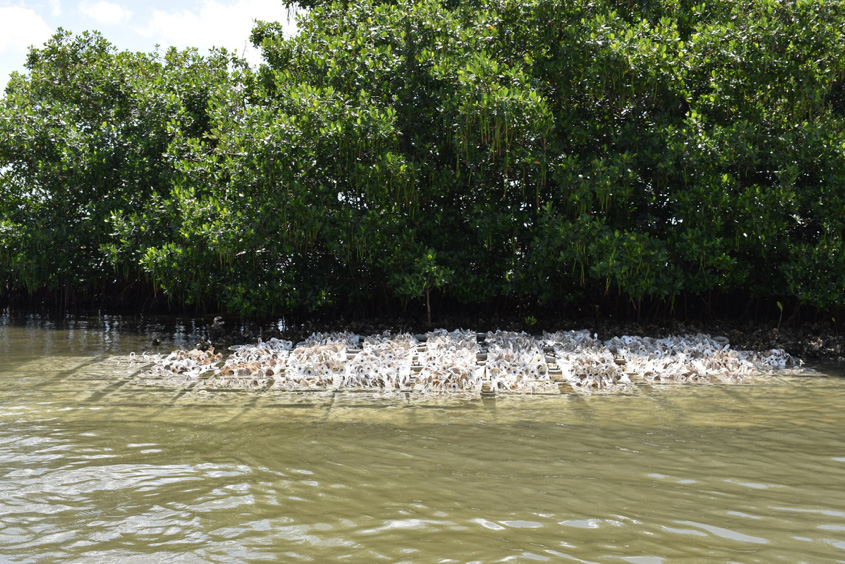
For all of our products it is not a one size fits all: you should apply them correctly and with sense. For instance, if you are restoring mangroves, you may need years of support from a structure. A material that degrades faster in these warmer areas will not be the right solution as it will simply weaken too fast.BESE-elements type 1 may offer the best solution. As a rule of thumb: the lifespan of the BESE-product used should be long enough to allow ecosystem establishment, while being short enough to have fully degraded before the restored ecosystem degrades again as part of its long-term ecosystem dynamics.
A second consideration is knowledge of the site conditions. BESE-elements are applicable in intermediate hydrodynamic conditions.
They will reduce currents and waves to some extent but are not suitable for coasts that suffer from constant high wave energy. So make sure you know your site and manage the risk of storm damage to prevent them washing up to the beach. Always start with a small pilot to see what happens during the first year. If the BESE-elements do not suffer, then try going larger. And if it fails before ecosystem establishment occurs, then clean up, despite it being a biodegradable product to ensure it doesn’t end up somewhere unwanted.
What happens if pieces of the product end up in the environment?
The material is heavier than water and won’t float. There is also scientific evidence that they are not harmful to plankton life (Vasilakis, 2017). Finally, the certification shows that the materials are neither toxic nor otherwise chemically polluting. But hey, let’s do our best not to pollute the environment anyway!
Active restoration with biodegradable products
Providing you with the current knowledge of biodegradable materials, should enable you to sensibly apply BESE-products, and of course we will be glad to help you with that.
We strive to use the best available materials and techniques. We adapt to changing scientific insights and continuously strive to improve, keeping up with the latest scientific knowledge. You can contact us any time for the latest updates and developments.
Do you think we can do better?
Please contact us and help us along! We are always open to improvement. Collaborations are key to speeding up knowledge for large scale ecosystem restoration techniques!
This Q&A and R&D are a produced by BESE in close collaboration with our partners from NIOZ, Rodenburg Biopolymers, ENEXIO Water Technologies and Technical University of Delft.